Why it matters more here than almost anywhere
Port St. Lucie built out in waves starting in the 1960s, and builders and homeowners planted oaks by the thousands. Many were laurel oaks (Quercus laurifolia) and water oaks (Quercus nigra) because they grow fast and look like the prized live oak when they're young. They are not the same tree. A live oak (Quercus virginiana) is a structurally strong, wind-tolerant tree that lives for centuries. A laurel oak is a fast, weak-wooded tree that lives 50 to 70 years, hollows from the inside as it ages, and then fails — a limb on the driveway one year, the whole crown in the pool cage the next storm. A huge share of the "mature shade trees" in PSL's older sections are laurel oaks now reaching exactly that age.
How to tell them apart
| Live oak | Laurel / water oak | |
|---|---|---|
| Overall form | Broad, low, spreading — wider than tall | Taller, more upright and oval |
| Leaves | Small, stiff, dark green, oblong, edges rolled under | Larger, thinner, glossier; often with a slight lobe or point |
| Leaf drop | Nearly evergreen; brief drop in spring | Drops heavily in late winter, looks half-bare |
| Bark | Dark, blocky, deeply ridged | Smoother when young, fluted and furrowed with age |
| Lifespan | 150–300+ years | 50–70 years |
| Typical failure | Rare; deadwood and end-weight in storms | Internal decay, hollow trunk, whole-tree failure |
The warning signs on an aging laurel oak
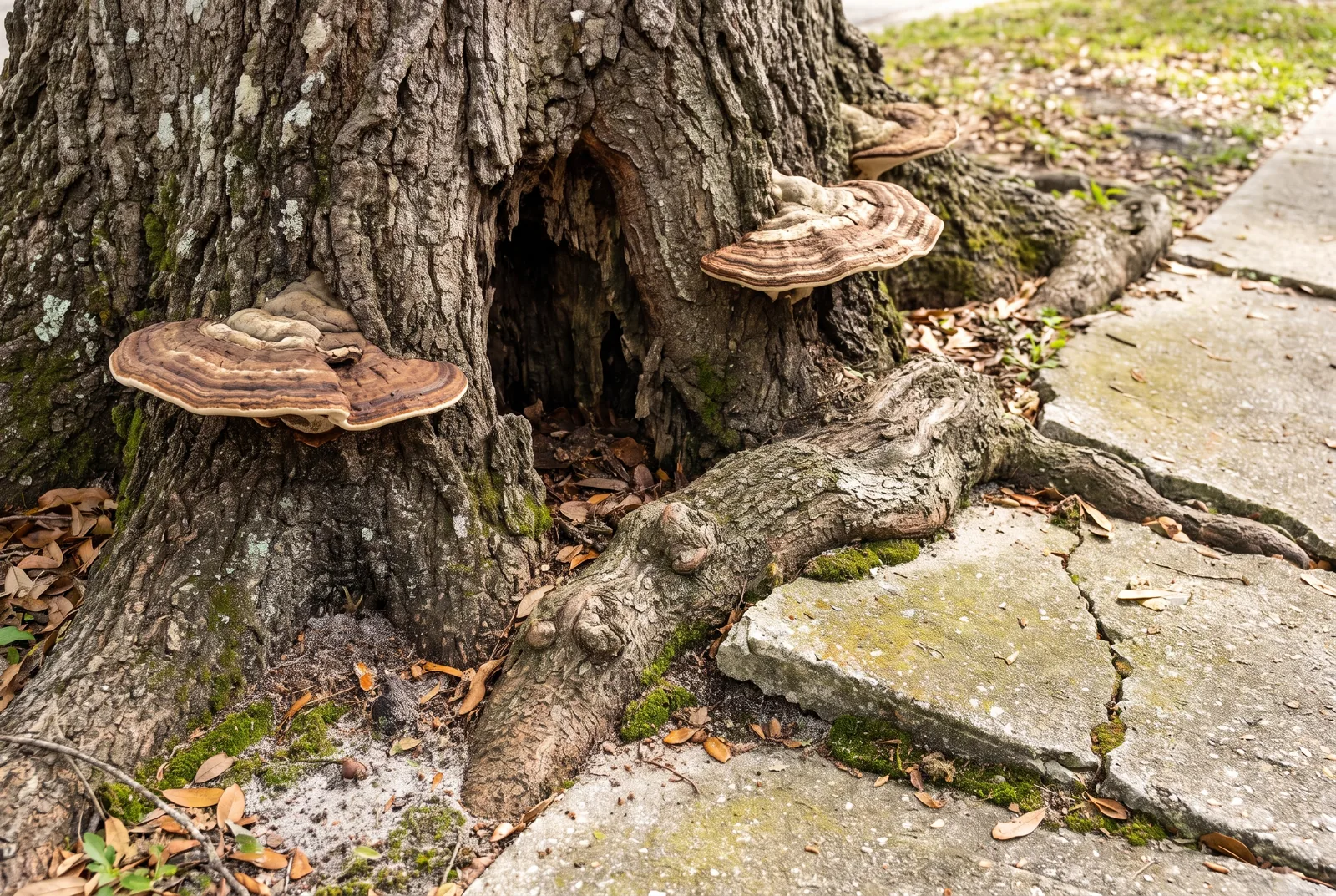
If you have a big oak near the house and any of these, get it looked at: a fluted or bottle-shaped trunk, shelf or bracket fungus (conks) at the base or on the trunk, a cavity or hollow you can put a hand into, carpenter ants or sawdust, large deadwood in the upper canopy, or a section of bark peeling away over dead wood. These are the tells that the tree is decaying from the inside — which is the failure that drops the whole thing in a storm, often without an obvious lean.
What to do with each
Live oak: keep it. It's an asset that raises your property value and shades your roof. It wants an arborist prune every few years — deadwood out, end-weight reduced, clearance from the house — and nothing more. Don't let anyone top it.
Laurel or water oak, young and sound: prune it structurally and enjoy it, but know it has a clock, and plan to replace it with a live oak, mahogany or another long-lived species before it fails.
Laurel or water oak, old and showing decay: this is the tree that comes through Treasure Coast roofs. Have it assessed; if it's hollowing over a target, removing it before hurricane season is far cheaper and safer than the emergency call afterward.
Not sure which you have? That's exactly what a free inspection is for — our arborist will tell you in two minutes, and we'll tell you honestly when a tree is fine and doesn't need our services at all.
Common questions
Is a water oak the same as a laurel oak?
Close enough for this purpose. Water oaks (Quercus nigra) and laurel oaks (Quercus laurifolia) are both fast, weak-wooded, short-lived oaks that were planted heavily as PSL grew, and both decline and fail decades sooner than a live oak. They're managed the same way: keep them while sound, watch for decay, replace before failure.
My laurel oak looks totally healthy — do I really need to worry?
A laurel oak can look fine from the outside while it's hollow inside, because the decay is internal. That's exactly what makes them dangerous — there's often no lean or obvious sign before a big limb or the whole crown fails. An arborist checks for the subtler tells (fungus, cavities, trunk shape) that reveal what the canopy hides.
Should I just remove every laurel oak preemptively?
No — a young, sound laurel oak is a fine shade tree for now, and we won't tell you to cut a healthy tree. The point is to know what you have, watch the aging ones, and act before the decayed ones fail. We'll tell you which category yours is in.
What should I plant instead?
Live oak if you have room for a big tree, southern magnolia, mahogany, gumbo limbo (very wind-tolerant), or a cluster of sabal palms. All are far longer-lived and more storm-worthy than the laurel oaks they'd replace, and better suited to our sandy soil.
Related: Oak & hardwood care · Tree removal · Storm prep · Cost guide